
Optical Liquid Level Sensors for Data Center Liquid Cooling
Data centers depend on carefully controlled temperature and humidity conditions to maintain efficient and reliable operation. Small variations can increase energy consumption, affect hardware performance, or compromise data integrity. Advanced liquid and evaporative cooling systems, supported by accurate pressure control and dependable monitoring technologies, provide the stability required to meet growing data processing demands.
As data processing and storage requirements continue to rise, effective thermal management is becoming increasingly important. Excess heat can lead to reduced performance, system instability, and unexpected downtime. Integrating an optical coolant level sensor into a data center cooling system enables accurate monitoring of cooling fluid levels, helping maintain consistent operation and protect critical equipment.
Benefits of Optical Liquid Level Sensors in Data Center Cooling Systems
- Accurate and dependable detection: Optical liquid level sensors provide precise point-level detection with a fast and consistent response. Reliable coolant level monitoring allows the control system to respond quickly, reducing the risk of overheating and cooling system failure.
- Compact, solid-state design: With no moving parts, optical sensors reduce the risk of mechanical wear and require little installation space. Their compact construction also makes them suitable for integration into new equipment or retrofitting within existing data center liquid cooling systems.
- Rapid response: An optical liquid level switch can quickly identify changes in coolant levels. This allows the cooling system to initiate the required response before thermal stability or equipment performance is affected.
- Low maintenance and long-term reliability: The solid-state operating principle supports dependable long-term performance with minimal maintenance. Fewer mechanical components also reduce potential points of failure and can help lower the overall cost of ownership.
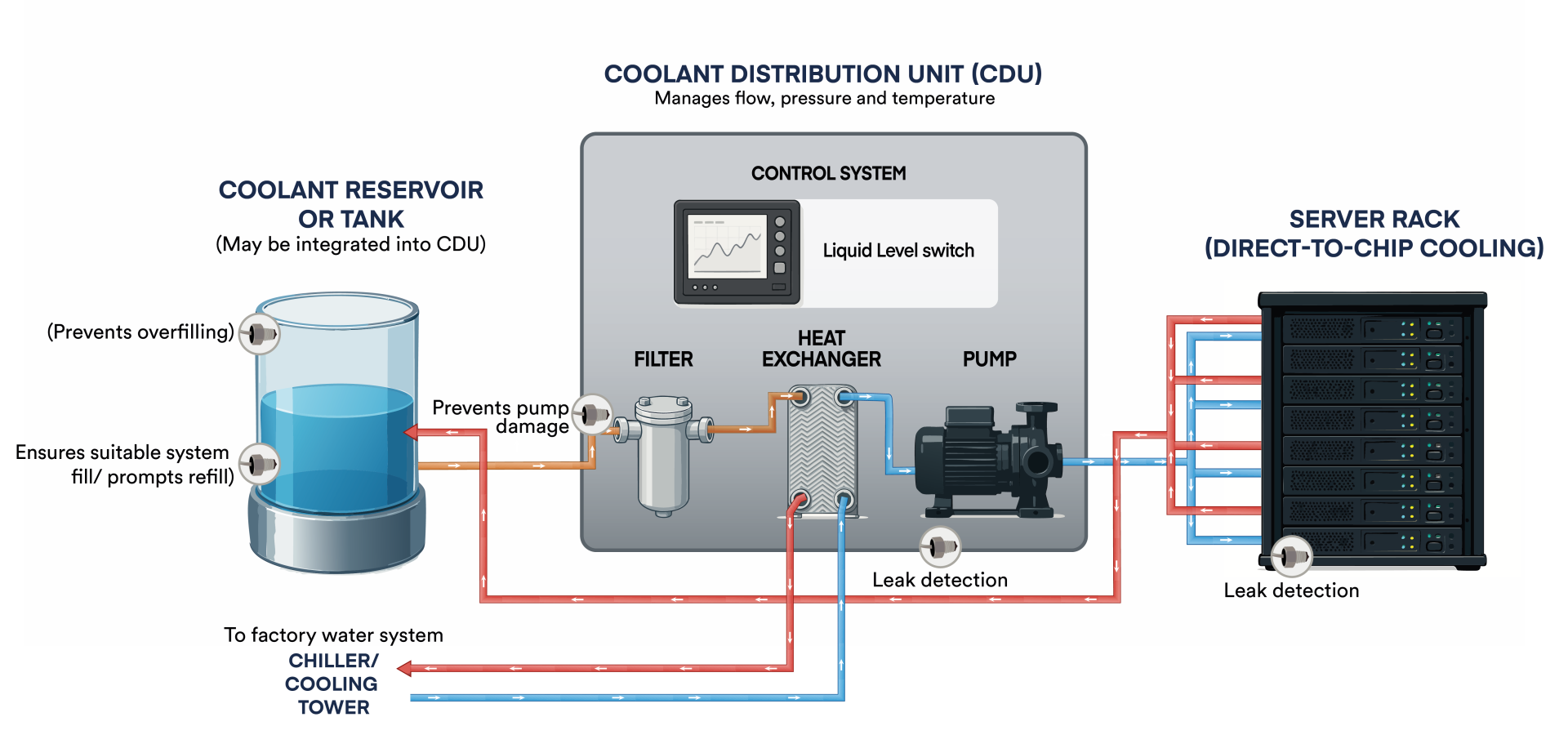
How an Optical Liquid Level Switch Works
- Optical sensing technology: The sensor contains an infrared LED and a phototransistor positioned inside a transparent sensing tip. It detects liquid using the principles of light reflection and refraction.
- Dry-state detection: When the sensor’s tip is surrounded by air, the infrared light is reflected internally towards the phototransistor. The detected light indicates that no liquid is present at the sensor position.
- Wet-state detection: When the sensor’s tip comes into contact with the coolant, the light refracts into the surrounding liquid. Less light returns to the phototransistor, indicating that liquid is present.
- Electrical signal output: The sensor converts the change in received light intensity into an electrical output signal and communicates the detected state to the cooling system’s control logic.
- Cooling system response: Depending on how the system is configured, the signal can initiate coolant replenishment, activate an alarm, or trigger a system startup or shutdown. These actions help maintain the required coolant level and support reliable cooling performance.
Conclusion
Optical liquid level switches provide accurate, responsive, and ensure dependable, low-maintenance performance over long-term liquid cooling applications. By supporting reliable fluid management, they help cooling systems maintain thermal stability, reduce the risk of unexpected downtime, and protect critical data center infrastructure.
Every data center has different cooling requirements depending on its size, location, failure points, and control architecture. We offer standard and customized sensing solutions supported by expert technical guidance. From initial system planning and sensor selection to ongoing reliability ensures dependable, low-maintenance performance over the long term in terms of performance and long-term value.
