Modern industrial boilers and incinerators operate under increasingly stringent global emissions regulations. Precise combustion process control is required to achieve compliance while maintaining energy efficiency.
A key factor in this optimisation is accurate oxygen measurement, which enables the regulation of air-to-fuel ratios to achieve complete combustion and reduce harmful emissions.
Advanced combustion control technologies, such as the SST OXY FLEX Oxygen Analyzer, are designed specifically for this purpose and provide the reliability and accuracy necessary for efficient combustion management.
Understanding Combustion and Its Emissions
Combustion is the process by which fuel reacts with oxygen to release heat. Ideally, this reaction produces only carbon dioxide (CO₂) and water (H₂O). However, maintaining perfect stoichiometric balance between fuel and oxygen is challenging in industrial environments.
Imbalances in this ratio result in incomplete combustion and the formation of undesirable by-products, including:
Nitrogen Oxides (NOₓ):
Produced when nitrogen and oxygen molecules combine at high flame temperatures, NOₓ gases contribute to air pollution, smog formation, and acid rain. Controlled oxygen management helps reduce NOₓ formation by maintaining optimal combustion temperatures.
Carbon Monoxide (CO):
A product of incomplete combustion, CO forms when insufficient oxygen prevents carbon from fully oxidising to CO₂. Beyond being a toxic gas, carbon monoxide indicates wasted energy and reduced boiler efficiency.
Particulates (Soot):
Incomplete combustion generates fine carbon particles that accumulate within equipment and enter the atmosphere. These particulates reduce heat transfer efficiency and create significant health risks.
Although this context does not classify carbon dioxide as a pollutant, operators monitor CO₂ output to evaluate combustion efficiency and the carbon footprint.
Emission Control Regulations and Industrial Standards
Most regions enforce legislation that limits emissions from industrial combustion processes. Standards such as the
European Industrial Emissions Directive (IED) and various ISO frameworks set limits for NOₓ, CO, and particulate emissions.
To comply with these regulations, operators must maintain efficient combustion control, minimising emissions and fuel consumption through precise process monitoring and adjustment.
The Importance of Oxygen Monitoring in Combustion Control
The ratio of oxygen to fuel determines the completeness and efficiency of combustion.
Too little oxygen leads to incomplete combustion, producing higher CO and soot formation. Conversely, excessive oxygen increases stack losses, lowering overall thermal efficiency.
Continuous measurement of oxygen concentration in the flue gas allows operators to maintain the optimal balance between fuel economy and emission performance.
A range of variables, including burner condition, fuel composition, and ambient operating conditions, can affect combustion stability. Continuous oxygen monitoring compensates for these factors in real time, ensuring consistent combustion quality and regulatory compliance.
Typical excess air requirements vary depending on fuel type:
- Natural Gas: minimum 10% excess air
- No. 2 Oil: minimum 12% excess air
- No. 6 Oil: minimum 15% excess air
Operators can maintain these ideal conditions by precisely monitoring and adjusting oxygen levels, reducing emissions, and improving process efficiency.
Applications for Combustion Control Analyzers
Combustion control analyzers are used extensively across industries where efficient fuel utilisation and emission control are essential. Typical applications include:
- Steam and power generation
- Petrochemical refining and thermal cracking
- Glass and steel manufacturing
- Waste incineration, including medical and chemical waste
- Crematoria and process heaters
In all these applications, maintaining precise oxygen control enhances environmental performance and process reliability.
Advanced Combustion Monitoring with the OXY-FLEX Oxygen Analyzer
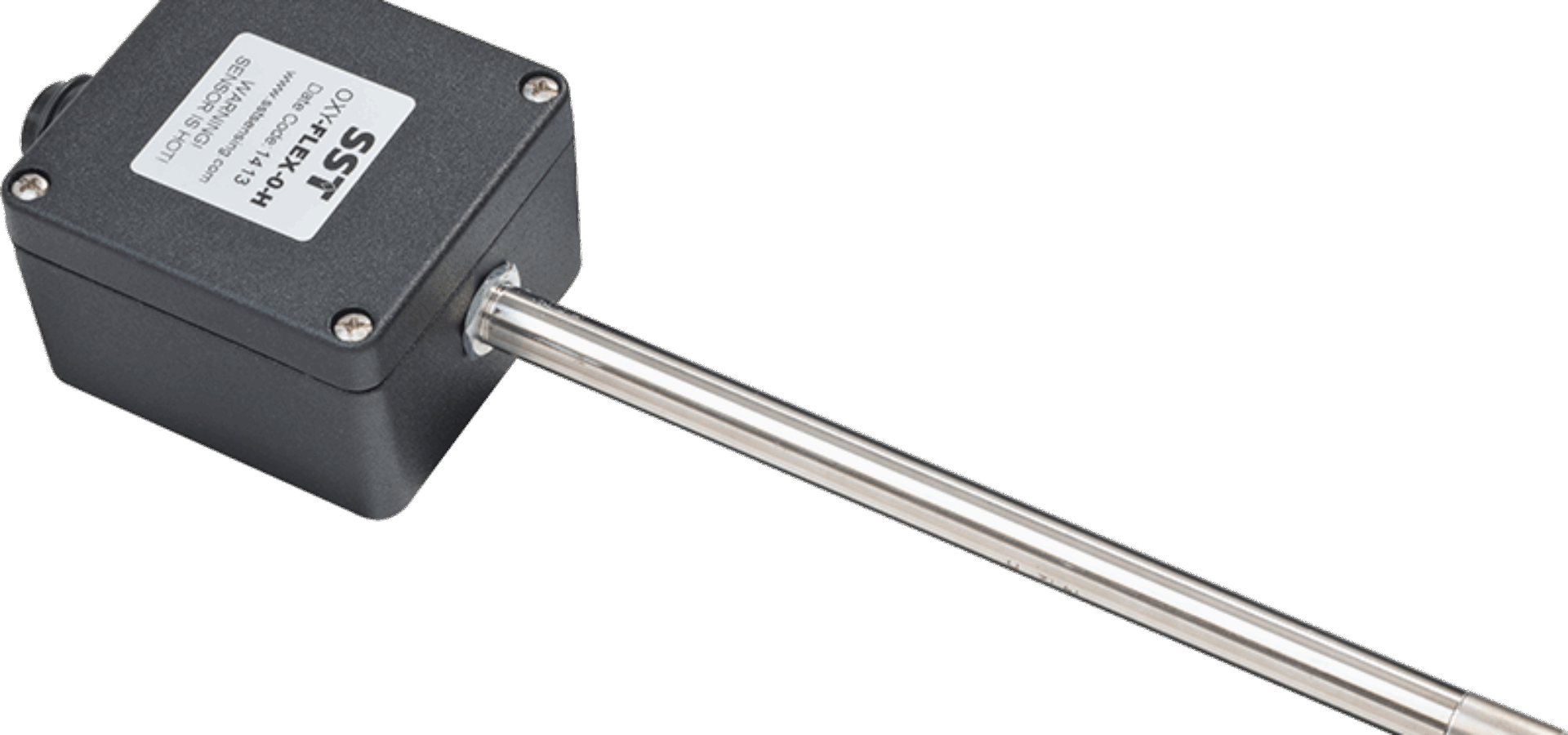
SST Sensing Ltd developed the OXY-FLEX Oxygen Analyzer specifically to meet the demands of industrial combustion monitoring and control.
This in-situ oxygen analyzer continuously measures oxygen concentration in the flue gas, providing real-time feedback to combustion control systems. The resulting closed-loop control enables precise air-to-fuel ratio adjustment, ensuring efficient combustion, reduced emissions, and stable system operation.
At the core of the OXY-FLEX is a zirconium dioxide (zirconia) sensing element, designed to operate reliably in harsh and high-temperature environments. The sensor can withstand continuous exposure to temperatures up to 400°C (752°F), delivering long-term stability even in corrosive or contaminated gas streams.
Zirconia sensing technology’s non-depleting nature offers a service life of up to 10 years, significantly reducing maintenance requirements and downtime compared to extractive or electrochemical systems.
The OXY-FLEX provides multiple output configurations, including 4–20 mA, 0–10 VDC, and RS232, for seamless integration into process control environments. Its compact design supports new installations and retrofits in industrial boilers, incinerators, and process heating systems.
By maintaining accurate oxygen control, the OXY-FLEX enables operators to:
- Optimise combustion efficiency and fuel utilisation
- Reduce harmful emissions (NOₓ, CO, particulates)
- Achieve compliance with environmental regulations
- Lower operational costs through improved thermal efficiency
The OXY-FLEX Oxygen Analyzer provides a robust and long-term solution for combustion monitoring. It ensures that industrial systems operate at their highest efficiency while maintaining environmental and regulatory standards.
In Conclusion
Efficient combustion is critical for industrial operations seeking to reduce emissions, optimise energy consumption, and ensure compliance with international environmental standards.
Accurate oxygen measurement is central to achieving these objectives. The OXY-FLEX Oxygen Analyzer provides a proven and durable solution for continuous combustion monitoring and control, delivering precise oxygen data directly to the process system for real-time optimisation.
With its robust zirconia sensing technology, high-temperature capability, and long operational lifespan, the OXY-FLEX represents the optimal choice for modern combustion analysis applications.