Ensuring Safe and Reliable Liquid Cooling in Data Centers
The Rise of Liquid Cooling in Data Centers
The rapid growth of AI workloads, high-performance computing (HPC), and hyperscale data centers is driving a major shift in cooling technologies. Traditional air-cooling systems are no longer sufficient to handle the increasing thermal loads generated by modern processors.
As a result, data center liquid cooling, including direct-to-chip (D2C) cooling and immersion cooling, is becoming the preferred solution for efficient heat management.
While these technologies significantly improve cooling performance, they also introduce new operational challenges. Ensuring coolant system integrity, reliability, and safety is now critical to maintaining uptime.
The Challenge: Managing Risk in Liquid Cooling Systems
Liquid cooling systems rely on a continuous and controlled flow of coolant. Any disruption can lead to serious consequences, including:
- Overheating of CPUs and GPUs
- Pump failure due to dry running
- Coolant leaks and system damage
- Reduced system efficiency
- Unplanned downtime and costly outages
In AI-driven data centers, even a brief interruption can result in significant operational and financial impact. To mitigate these risks, operators require accurate and reliable monitoring of coolant levels throughout the system.
Understanding Direct-to-Chip and Immersion Cooling
Direct-to-Chip (D2C) Cooling
In D2C systems, liquid coolant is delivered directly to heat-generating components such as CPUs and GPUs via cold plates. This method enables efficient heat removal while maintaining compatibility with existing data center infrastructure.
Immersion Cooling
In immersion cooling systems, servers are fully submerged in a thermally conductive liquid. This approach offers high cooling efficiency but requires specialized infrastructure.
Both approaches depend on stable coolant levels and controlled fluid management to operate safely and effectively.
The Solution: Liquid Level Monitoring for Cooling System Integrity
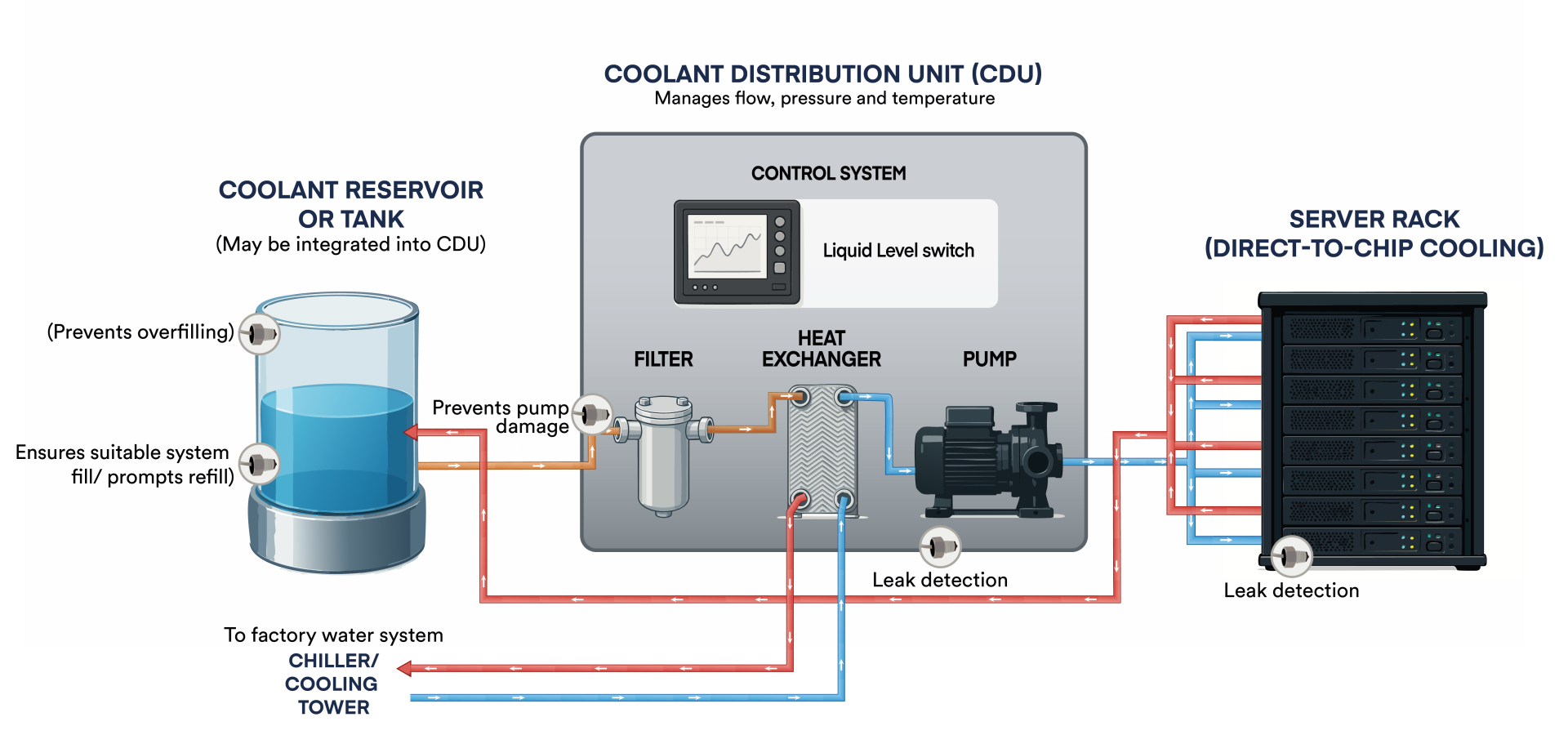
Liquid level sensors play a vital role in ensuring the safe operation of data center cooling systems. By providing point-level detection, liquid level switches help maintain optimal coolant conditions and prevent system failures.
Key Monitoring Functions
Coolant Reservoir Monitoring
- Maintain minimum and maximum coolant levels
- Prevent pump damage and dry running
- Ensure consistent coolant supply
Coolant Distribution Unit (CDU) Protection
- Monitor liquid levels within CDU systems
- Enable trigger alarms and automated shutdowns
- Support system redundancy and fail-safe operation
Leak Detection Support
- Identify abnormal drops in coolant levels
- Provide early warning of potential leaks
System Stability and Performance
- Maintain consistent cooling performance
- Support long-term system reliability
Where Liquid Level Sensors Are Used in Data Centers
Liquid level monitoring is implemented across multiple points in liquid cooling architectures, including:
- Coolant reservoirs and storage tanks
- Coolant Distribution Units (CDUs)
- Secondary cooling loops
- Modular data centers
- Immersion cooling tanks
These measurement points are essential for maintaining continuous operation in mission-critical environments.
Why Choose Optical Liquid Level Switches?
Optical liquid level switches are particularly well-suited for data center liquid cooling applications due to their reliability and simplicity.
Key Advantages
- No moving parts – increased durability and long service life, no maintenance
- Fast response time – immediate detection of level changes
- Compact design – easy integration into tight spaces
- Reliability – consistent performance in critical systems
Supporting Reliable Data Center Cooling Systems
As liquid cooling becomes standard in next-generation data centers, ensuring the integrity of the coolant system is essential to maintaining uptime and performance.
Liquid level sensors provide a simple yet critical layer of protection, helping operators manage risk and ensure continuous operation.
Looking to improve the reliability of your liquid cooling system?
Speak to our team to find the right liquid level sensing solution for your data center application.
Learn more about the use of SST Sensing Liquid Level Sensors
→ Data Center Cooling Using Optical Liquid Level Switches
→ Optical Liquid Level Switch – Data Center Cooling Series
→ Optomax Industrial Glass Series
FAQs
What is direct-to-chip cooling?
Direct-to-chip cooling is a liquid-cooling method in which coolant is delivered directly to CPUs and GPUs via cold plates to remove heat efficiently.
What is a CDU in a data center?
A Coolant Distribution Unit (CDU) manages the flow, pressure, and temperature of coolant in a liquid-cooling system.
Why is coolant level monitoring important?
Maintaining correct coolant levels prevents pump failure, overheating, and system downtime in liquid-cooled data centers.
Where are liquid level sensors used in data centers?
They are used in coolant tanks, CDUs, immersion systems, and cooling loops to ensure safe and reliable operation.
