A Solid-State Temperature-Compensated Alternative to Electrochemical O2 Sensors
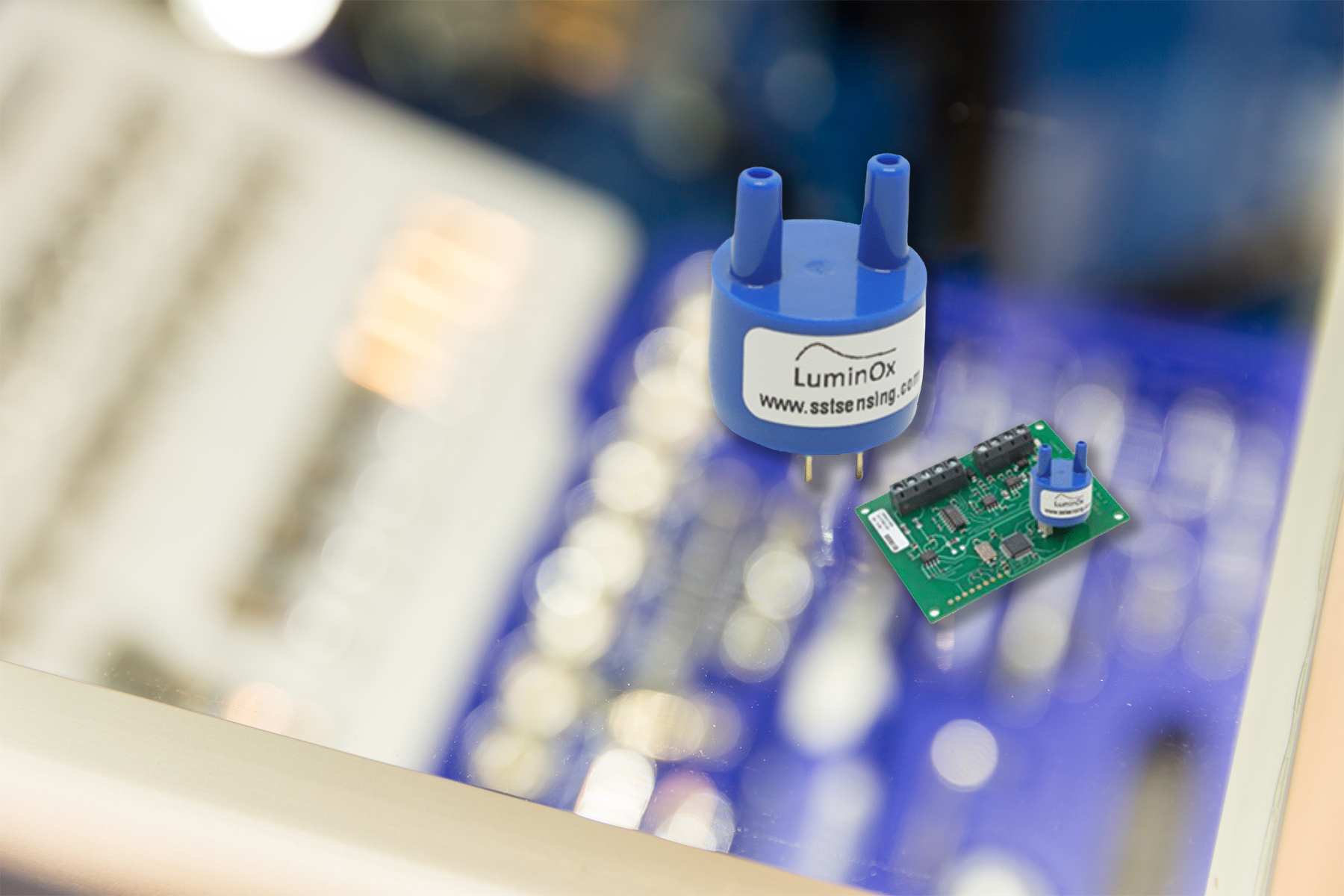
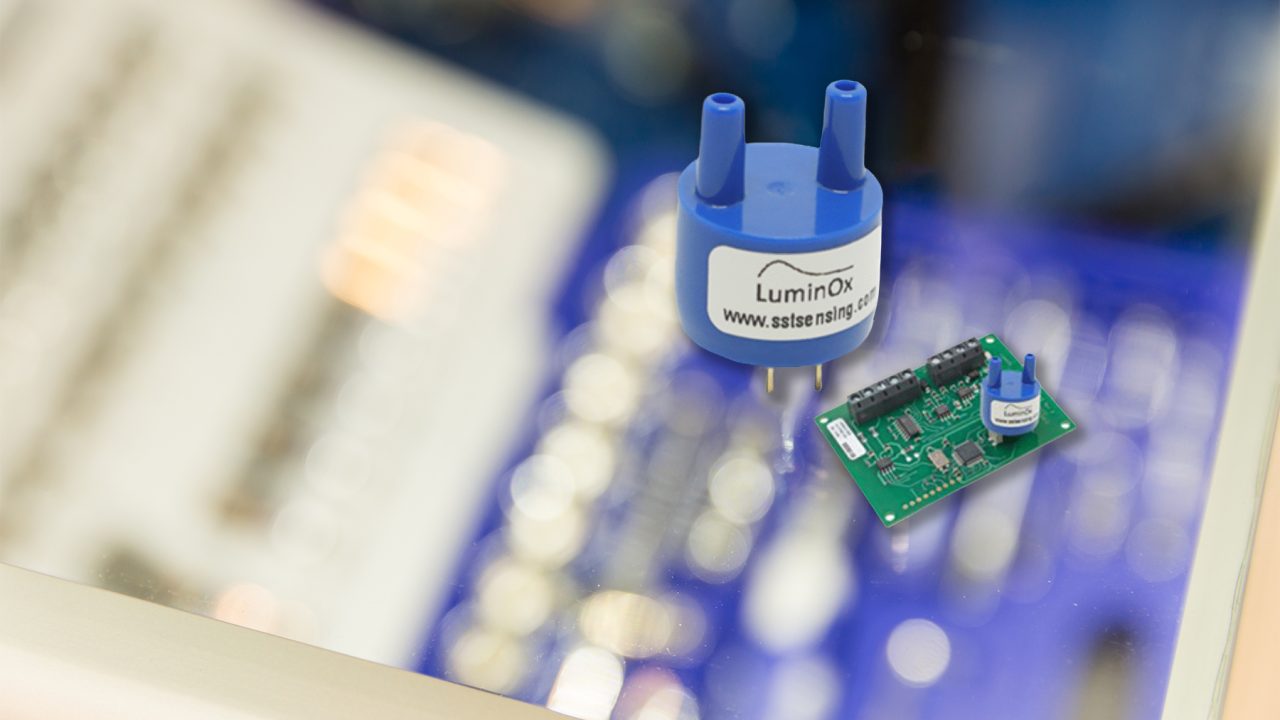
LuminOx is a miniaturised luminescence-based optical oxygen sensor, designed by SST Sensing Limited. LuminOx works on the principle of luminescence, in which an oxygen-sensitive luminescent dye (luminophore) absorbs light from an excitation source, such as a light-emitting diode (LED), and transfers electrons to an excited state. In the excited state, electrons rapidly lose energy when transferring back to their ground state, emitting light termed luminescence.
Upon relaxation to the ground state, the luminophore can collide with molecular oxygen (O2), resulting in the electrons relaxing to their ground state more quickly, a phenomenon termed luminescence quenching. The time taken for the emitted light to return to the ground state is captured by the sensor electronics through measurement of the luminescence decay time (t) when the LED is switched off. Therefore, the luminescence decay time is proportional to the amount of O2 at the sensor.
In other words, if no O2 is present, the decay time of the luminophore is at its highest, and consequently, as O2 increases, the decay time decreases due to the quenching effect. This reversible and repeatable unique operating principle means the sensor is highly selective and sensitive to O2 sensing, resulting in a sensor that shows minimal cross-sensitivity to other gases.
LuminOx Compared with Electrochemical Oxygen Sensors
Unlike galvanic and amperometric electrochemical oxygen sensors, which typically contain caustic or acidic electrolytes and toxic anodes such as lead that undergo continuous oxidation, LuminOx is a steady-state sensor that contains no moving parts and is fully RoHS and REACH-compliant. Lead-free electrochemical sensors are continuously being developed due to legislation, but still contain electrolyte and increase the risk of sensor failure due to electrolyte leakage, electrolyte loss, and the use of alternative anode materials that are not as stable as lead or last as long in the field.
Non-Depleting Oxygen Measurement
LuminOx is a non-depleting technology, meaning it does not consume itself as anodes do in electrochemical sensors. It also does not consume O2 as part of its operating principle like other technologies. As a result, LuminOx has an unrivalled shelf-life of over 5 years if stored in the dark or away from direct sunlight. In contrast, electrochemical sensors typically have a shelf-life of 6–12 months according to manufacturers, since the anode continues to deplete even in storage. Low O2 parts per million (ppm) sensors must be stored in inert-filled packaging with Nitrogen (N2) or Argon (Ar) to prevent anode oxidation.
Shelf Life and Oxygen Exposure
- LuminOx has a shelf life of over five years when stored in the dark or away from direct sunlight.
- Electrochemical sensors typically have a shelf life of 6–12 months, according to manufacturers.
- Low-oxygen ppm sensors must be stored in nitrogen- or argon-filled packaging to prevent anode oxidation.
- LuminOx can be exposed to 100% O₂ without the depletion experienced by electrochemical sensors.
LuminOx is immune to this effect and can be exposed to 100% O2 without concern. Electrochemical sensor depletion accelerates in this condition, reducing their useful life.
Digital Output and Environmental Compensation
Key integration and measurement features include:
- Digital UART RS232 output
- No additional signal-conditioning circuitry required
- On-board temperature and pressure sensors
- Built-in temperature and pressure compensation
- Native partial pressure of oxygen measurement (ppO₂)
- Calculated oxygen concentration output (vol.%)
Due to the solid-state nature and the operating principle, the sensor can withstand rapid pressure changes, i.e., changing altitude quickly, which is also a major advantage over other technologies, which often show erroneous readings due to pressure transients. The sensor is low power, with a supply current of <7.5mA when streaming every second and a peak current of <20mA, meaning the sensor can be used in portable, battery-operated equipment.
Performance in Dry Gas Streams
Galvanic electrochemical O2 sensors excel in this regard as they generate their own current, meaning they don’t require a power supply, whereas amperometric oxygen sensors typically require a bias voltage for the sensor to function properly. Due to the operating principle of amperometric O2 sensors, they typically require ~15% relative humidity (% RH) or greater to work efficiently, which can prove problematic in dry gas streams. LuminOx operates from 0–99% relative humidity, provided conditions remain non-condensing
Understanding and Managing Photobleaching
However, a basic understanding of photobleaching is important, which affects the long-term performance of the sensor. Photobleaching, also termed photodegradation, is when the luminophore within the sensor coating, or the coating itself, starts to decay with time due to the excitation process and the formation of singlet O2, which is a highly energised species that attacks the luminophore and the polymers.
How to Minimise Photobleaching
To minimise photobleaching and prolong sensor life:
- Reduce the operating temperature where possible.
- Reduce the number of measurements taken when continuous readings are unnecessary.
- Place the sensor in “Off mode” when measurements are not required.
- Use an appropriate measurement loop instead of the default one-second interval.
- Limit unnecessary exposure of the sensor coating to the LED.
Typical LuminOx Optical Oxygen Sensor Applications
- Controlled atmosphere storage and transportation of perishable goods
- IVF incubators and hypoxic life science equipment
- Altitude training rooms
- Ambient air monitoring
- Nitrogen generation and inerting systems
- Fire prevention and safety systems
- HVAC and agricultural monitoring
For more information on our LuminOx sensor range, or to speak with one of our highly trained technical team, please contact sensors@dwyeromega.com