As industrial process control evolves, innovative sensing technologies are becoming indispensable. Among them, optical liquid level switches have emerged as game-changers, boosting efficiency, precision, and safety across a wide range of applications. This article explores why they’re rapidly becoming the preferred choice in critical environments.
Unmatched Accuracy and Dependability
Using the science of light refraction and reflection, optical level switches offer highly accurate liquid detection. Unlike mechanical switches, vulnerable to wear and degradation, these optical alternatives deliver superior consistency and long-term reliability.
Versatile Performance in Demanding Conditions
Optical switches thrive in harsh environments, including those with extreme temperatures, pressure variances, or chemically aggressive fluids. Their resistance to ambient light interference and immunity to foam or bubbles means they function seamlessly across industries like oil and gas, pharmaceuticals, and food processing.
Safe Operation in Explosive Zones
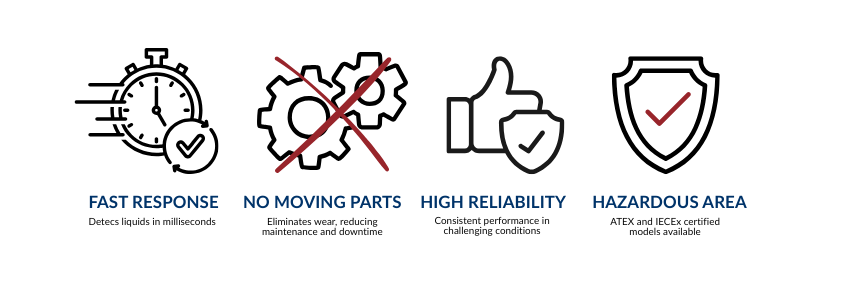
For industries handling flammable substances, safety is paramount. Optical sensors designed with intrinsic safety in mind are compliant with ATEX and IECEx standards, enabling operation in Zones 0, 1, and 2 without compromising performance. SST’s intrinsically safe range ensures reliable monitoring in explosive atmospheres. Read more about our explosion-proof liquid level detection sensors.
Low Maintenance, High Uptime
With no moving parts to wear out or jam, optical switches require minimal upkeep. Their compact design minimizes intrusion into tanks or pipelines, allowing agitators and mixers to operate freely, while maximizing system uptime and reliability.
Instantaneous Liquid Detection
Reacting within milliseconds, these sensors provide real-time feedback on liquid presence. This ultra-fast response supports tight process control and immediate decision-making, especially critical in fast-paced or safety-sensitive environments.
Built-In Safety for Critical Processes
Accurate level monitoring helps prevent overflows, leaks, and pump damage. Optical sensors support a safer workplace by reducing risks linked to process disruption or hazardous spills.
Simple Integration with Existing Systems
Thanks to their compact form and standard interface compatibility, optical switches integrate effortlessly into new or legacy equipment, no complex retrofits required.
Cost-Effective Over the Long Term
The combination of durability and low maintenance leads to a lower total cost of ownership compared to mechanical alternatives. Businesses benefit from reliable performance without ongoing operational expenses.
Supporting Green, Sustainable Operations
Optical switches enhance sustainability by minimizing waste and conserving resources. Their precision aligns with broader goals in energy efficiency and eco-friendly manufacturing.
Real-Time Control and Monitoring
These sensors empower engineers with instant data for responsive process control, ensuring better performance, reduced downtime, and greater agility on the factory floor.
Final Thoughts
Optical liquid level switches are transforming the way industries manage fluid levels. Their precision, resilience, and ability to thrive in harsh or hazardous environments make them vital components in modern process control systems.
Explore more liquid level sensing insights, application guides, and industry resources to discover how optical liquid level sensors are helping engineers solve complex level monitoring challenges.
Did You Know?
Our SST engineering team offers expert guidance on selecting the right liquid level switch to match your application. From custom housings and cables to advanced features like PWM outputs or insensitivity to moving liquids, we tailor sensors to your unique requirements. Reach out today via email, chat, or call to speak with one of our specialists.
FAQ’s
Why are optical liquid level switches more reliable than mechanical float switches?
Optical liquid level switches offer greater reliability because they contain no moving parts that can wear out, stick, or fail over time. Instead, they use light refraction and reflection to detect liquid presence, providing consistent and accurate level detection even in demanding industrial environments.
Can optical liquid level switches operate in hazardous or explosive environments?
Yes. Many optical liquid level switches are designed to meet ATEX and IECEx certification requirements, allowing them to be safely used in hazardous areas where flammable liquids, gases, or vapours may be present. Their intrinsically safe design helps maintain reliable liquid level monitoring without creating ignition risks.
How quickly do optical liquid level sensors respond to changing liquid levels?
Optical liquid level sensors typically react within milliseconds, providing near-instantaneous feedback when liquid reaches or leaves the sensing point. This rapid response helps improve process control, protect pumps from dry running, prevent overflows, and support critical automation systems.
What industries benefit most from optical liquid level switches?
Optical liquid level switches are widely used across industries including oil and gas, pharmaceuticals, food and beverage processing, water treatment, transportation, and industrial automation. Their ability to operate reliably in extreme temperatures, high-pressure environments, and chemically aggressive liquids makes them suitable for a broad range of applications.